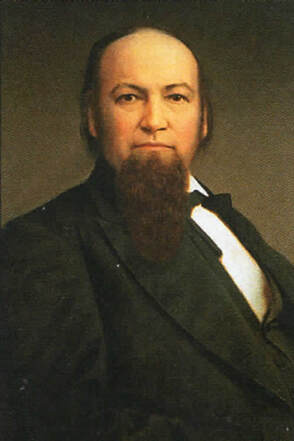
Col. Albert Smith Marks
Faces of the Battlefield
by Thomas Zei
By Thomas Zei
Albert Smith Marks was born in Owensboro, KY on October 16, 1836. His father died when Albert was fourteen and he left school to help his mother run the family farm. When he became nineteen, he moved to Winchester, TN to work in a law firm operated by his mother’s cousin. After reading many law books, he was admitted to the Tennessee Bar and became a partner in the cousin’s firm.
Although pro-Union, he joined the Confederate Army when the Civil War started. He was elected as the Captain of Company E of the Tennessee 17th Regiment. In May 1862, Marks received a promotion to major. A month later, he was promoted to colonel.
At the time of the Battle of Stones River, the 17th Tennessee Regiment was assigned to the brigade led by General Bushrod Johnson in General Patrick Cleburne’s division. The initial
Johnson’s Brigade fell into formation as the Confederates continued the wheel to attack the Union’s line from the south. The brigade moved up Gresham Lane with Colonel Marks commanding the 17th Tennessee on the west side of the road. Here they met resistance from the Union brigade led by General Sydney Post.
Colonel Marks marched his forces of about 600 men across a harvested cornfield. Here, he noticed cannon fire before him. Official reports noted that Mark’s marched his troops to within 150 yards of the cannons where he supposedly said “Boys, do you see that battery? It is ours, is it not?” At this point, he found the answer when shrapnel from a cannon shell struck Colonel Marks severely wounding his ankle. He was taken from the battlefield to a hospital where his leg was later amputated.
Major General Cleburne would later write:
“He was the most memorable above every officer in my Division, to which he belonged. For zeal, activity and good judgement in the management of his men. The result was he had the best disciplined and equipped Regiment in my Division, if not in the Army of Tenn.”
Marks after his recuperation stayed with the Confederate Army. He put his legal training to use and became the Judge Advocate General for Nathan Bedford Forrest’s unit in 1864.
After the Civil War, he returned to Winchester, TN where he was elected judge in 1870. In 1878, he was elected governor of Tennessee and served one four-year term. He died in Nashville on November 4, 1891 and is buried in Winchester.