William Shannon
A National Cemetery Story
by Thomas Zei
(c) 2025 by Thomas Zei. Used by permission by Friends of Stones River National Battlefield and all rights reserved by the author.
(thanks to Michael Hoover for providing information for this article)
William Shannon was born in 1870 in Rutherford County. The 1880 US Census shows him living to the west of Murfreesboro in District 7. He later moved to New York City and became a cook.
When the Spanish-American War started in 1898, he enlisted in the 24th Infantry Regiment, Company F. The unit was deployed to Cuba and was later involved in the famous Battle of San Juan Hill. This battle is known for Theodore Roosevelt leading his Rough Riders in the charge against the Spanish forces near Havana. When the conflict ended, the 24th Infantry was mustered out and he was honorably discharged in 1899.
Shannon, though, quickly re-enlisted in the military, this time with the 25th Infantry Regiment. The enlistment roster indicates that Shannon’s stated occupation as “soldier”. The regiment was soon deployed to fight in the Filipino uprising in the Philippines and they arrived on the island of Luzon in August, 1899.
As they pushed north on the island towards Castellaño, a skirmish occurred between Shannon’s company and the Filipinos on January 29, 1900. Adjutant-General Barry reported the following:
“Lieutenant Martin reported yesterday that on 29th instant Lieutenant Schenck, Twenty-Fifth Infantry, with 40 men encountered force of about 500 insurgents in vicinity of Castellaño attacked them at once, and was falling back slowly, expecting to be reinforced by additional company. Schenck and 3 men killed, 3 wounded. Killed and wounded brought to Manila. When additional company came up enemy was routed and scattered to the mountains.”
Private William Shannon was killed during this action. His body was returned to Tennessee and he was buried in grave number 6139 in Section P. It is the first grave in this section. A simple headstone with 6139, his name and “U. S. A.” marks his grave.
But the simple headstone does not tell the complete story. Private Shannon’s infantry units were both comprised of African-American soldiers. Both the 24th and 25th Regiments were formed after the Civil War and were deployed to the expending West to protect settlers, build forts and engage in the Indian Wars. The members of these units were called Buffalo Soldiers because the soldiers’ hair reminded Native Americans of the hair on the bison out on the plains where these soldiers were initially deployed. These soldiers performed their duties and fought bravely despite the discrimination they often faced.
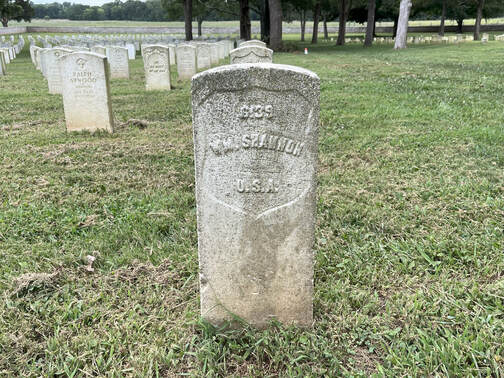
After his death, his body is returned to Murfreesboro and he became the cornerstone of the new Section P. There is great irony in this honor. As discussed in the article on Sections P and Q, a policy was created controlling burials within the Stones River National Cemetery burying only Whites in Section P and only Blacks in Section Q. It was only when Section P became full in the late 1950’s were Whites and Blacks buried together in the remaining space in Section Q. But because Shannon’s headstone only stated U.S.A. but not his unit, it seems that it was overlooked that the section already had a Black soldier buried there. Section P was inter-racial from the very beginning.
He died a hero and received a hero burial in the national cemetery. But even after death, he was a trailblazer in the history of the cemetery.